
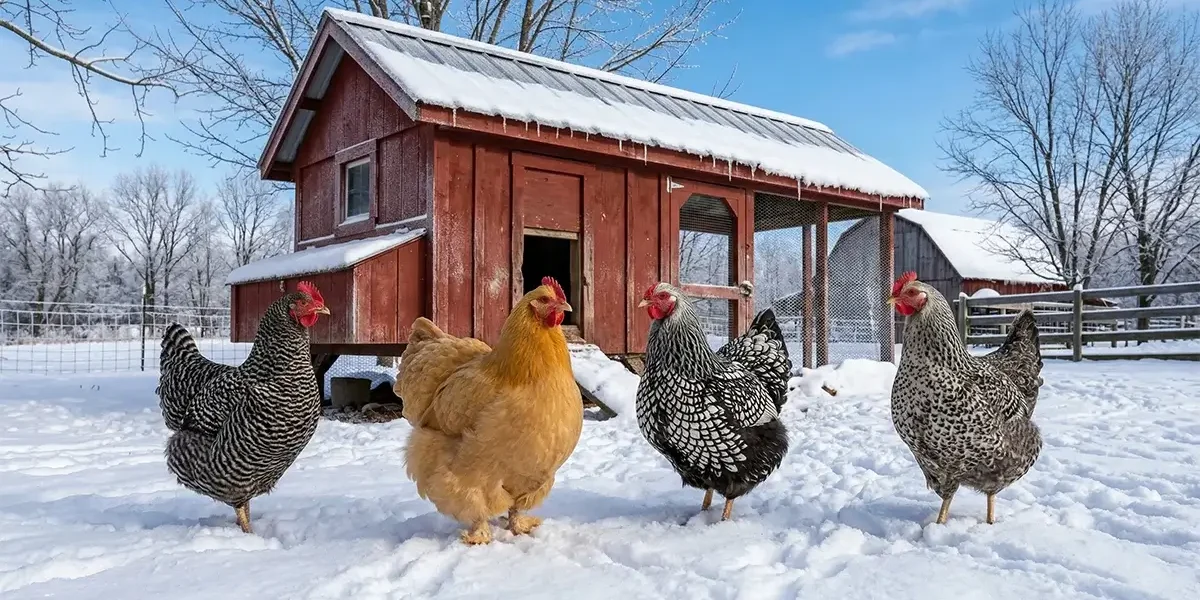
Choosing the right chicken breed for your climate is one of the most important decisions a backyard flock owner can make. In cold northern states — anywhere that regularly sees temperatures below 20°F, hard freezes, and significant snowfall — not all breeds thrive equally. The wrong breed in a harsh winter can mean frostbitten combs, reduced egg production for months, and stressed birds more susceptible to illness. The right breed will lay through the coldest months, handle confinement during blizzards, and barely notice temperatures that would send a Mediterranean breed into complete laying shutdown. This guide covers the best chicken breeds for cold weather, what makes them cold-hardy, and what you need beyond breed selection to keep winter egg production strong.
What Makes a Chicken Breed Cold-Hardy?
Cold hardiness in chickens comes down to a combination of physical traits and behavioral tendencies. Small rose or pea combs are the most important physical trait: the single comb — the classic tall, pointed red comb — is the most prone to frostbite because of its large surface area and upright exposure. Breeds with rose combs (low, flat, close to the head) or pea combs (three small ridges) have dramatically less tissue exposed to cold. Dense, full feathering provides better insulation. Compact, blocky body type retains heat more efficiently than a large, lean bird — dual-purpose heritage breeds tend to have this heat-retaining conformation. Behavioral calm in confinement is also critical, since during winter storms chickens may be confined to the coop for multiple consecutive days.
The 8 Best Cold-Hardy Chicken Breeds
1. Dominique
America’s oldest recognized breed and arguably the most cold-hardy chicken available. Developed in the northeastern United States specifically to withstand harsh winters, the Dominique has a tight rose comb that sits flat against the head with essentially zero frostbite risk, dense tight feathering, and a compact body that retains heat efficiently. Dominiques lay 230 to 275 light-brown eggs per year — excellent production for a truly cold-hardy breed — and their calm, docile temperament makes them easy to manage in winter confinement.
2. Plymouth Rock (Barred Rock)
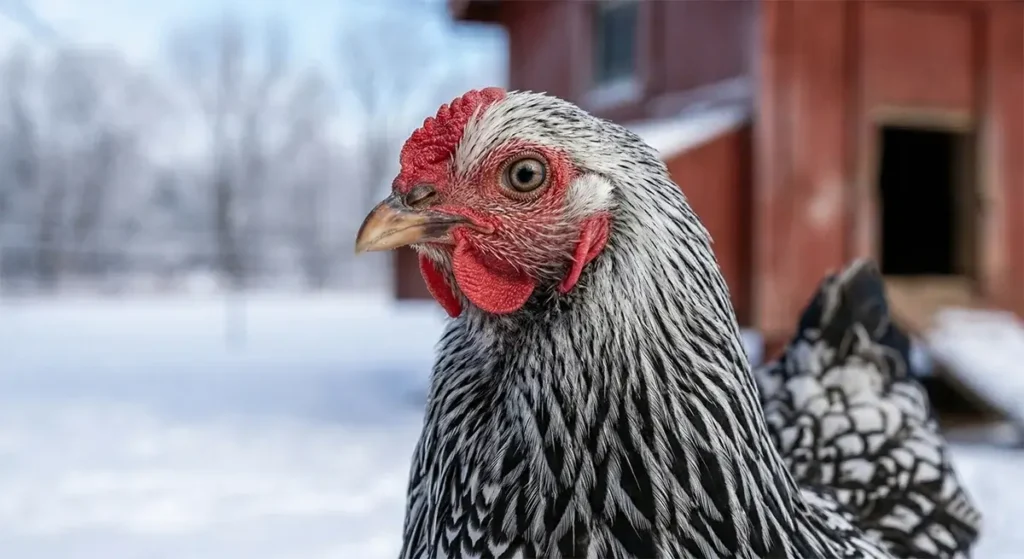
Developed in New England, the Barred Rock is well-adapted to cold winters and lays 200 to 280 large brown eggs per year. Its single comb is moderate in size — manageable with proper coop ventilation and a thin layer of petroleum jelly applied on the coldest nights — and its overall winter hardiness is excellent. One of the most popular homestead breeds in America for good reason.
3. Rhode Island Red
Developed in Rhode Island in the 1890s for New England winters, Rhode Island Reds are among the most productive cold-weather layers available, producing 250 to 300 large brown eggs per year and maintaining respectable winter production even without supplemental lighting. The single comb is moderately susceptible to frostbite in extreme cold, but the breed’s overall winter hardiness is excellent.
4. Wyandotte
The Wyandotte’s rose comb is its defining cold-weather advantage — flat, close to the head, and essentially frostbite-proof. Combined with a compact, rounded body, dense feathering, and calm disposition, the Wyandotte is one of the best-designed cold-weather breeds available. They lay 200 to 240 light to medium brown eggs per year and are available in over a dozen stunning color varieties, Silver Laced being the most popular.
5. Australorp
Combining extraordinary laying ability (250 to 300 eggs per year) with a calm, adaptable temperament that handles cold confinement well, the Australorp is an outstanding cold-weather layer. Their single comb requires some management in extreme northern climates, but their overall hardiness is very good. Black Australorps are the most common variety.
6. Buff Orpington
Their extraordinarily calm, friendly temperament combined with dense, fluffy feathering and good cold tolerance makes Buff Orpingtons a family favorite. They lay 200 to 280 light brown eggs per year and handle winter confinement beautifully. Children can interact with them daily without stress. Single comb requires some cold-weather management in extreme climates.
7. Buckeye
Developed in Ohio specifically for cold-weather performance, the Buckeye has a small pea comb and compact body making it one of the most genuinely frostbite-resistant breeds available. They are active, good foragers, and have an assertive, almost dog-like personality. Egg production runs 150 to 200 medium brown eggs per year — lower than production breeds but very consistent through winter.
8. Chantecler
Bred in Quebec, Canada to maximize cold-weather performance, the Chantecler has an almost completely flat cushion comb and tiny wattle — the minimum exposed tissue possible in a chicken. If you are in northern Minnesota, Maine, upper Michigan, or Canada, the Chantecler is the most frostbite-resistant breed available. Production is 200 to 250 cream to light brown eggs per year. Find breeders through the Livestock Conservancy, which maintains a breeder directory for rare and heritage breeds and whose conservation work supports the genetic diversity of American livestock breeds.
Managing Winter Egg Production
Even the most cold-hardy breeds will reduce or stop laying when day length drops below 14 hours — not because of cold, but because reduced light fails to trigger the hormonal response that causes ovulation. A simple incandescent or LED bulb on a timer can maintain 14 to 16 hours of total light through winter, sustaining near-summer egg production rates. Set the timer to add light in the early morning hours rather than the evening. Increase caloric density in winter feed through high-protein treats like black soldier fly larvae, mealworms, or sunflower seeds — cold weather increases caloric demand as chickens burn more energy to maintain body temperature.
Coop Management for Cold Weather
Proper winter coop management matters as much as breed selection. Maintain excellent ventilation — moisture, not cold, is the primary cause of frostbite and respiratory disease in winter. Ammonia from droppings combined with condensation in a poorly ventilated coop will cause health problems regardless of how cold-hardy your breed is. Keep vents open at the roofline where cold air rises and exits without creating drafts at bird level.
Breeds to Avoid in Cold Climates
Mediterranean breeds developed for hot, dry conditions — Leghorns, Minorcas, Anconas — have large single combs and thin feathering that makes them genuinely poor performers in harsh winter climates. Silkies, despite their fluffy appearance, are not cold-hardy — their silk feathers do not provide the same insulation as normal plumage and get wet easily in snow and rain.
Final Thoughts
Choosing a cold-hardy breed is one decision — but it is only the foundation. A cold-tolerant breed in a poorly ventilated, overcrowded coop with inadequate nutrition will still underperform. Get the coop right, the nutrition right, and the lighting right, then choose your breed from the list above, and you will be collecting eggs through every January your flock is of laying age.

Leave a Reply