
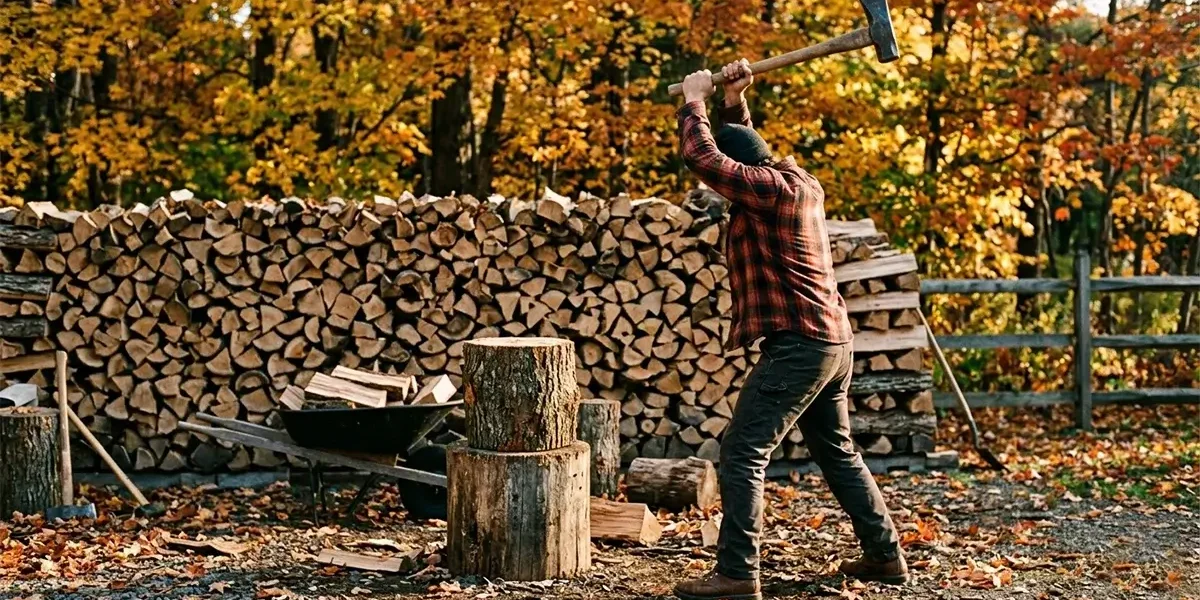
Heating with wood is one of the most tangible expressions of rural self-sufficiency. There is something deeply satisfying about looking at a full woodshed in October, knowing that your family will be warm through January without writing a check to the propane company. But a good firewood operation does not happen by accident. It requires the right tools, the right technique, and most importantly, the right timing. This guide covers everything you need to split, season, and stack firewood the right way.
The Fundamental Rule of Firewood: Cut and Split a Year Ahead
This is the rule that separates homesteaders who always have good, dry firewood from those who struggle with smoky, inefficient fires and creosote-choked chimneys every winter. Green (freshly cut) wood contains 50% or more moisture by weight. Burning green wood produces far less heat, far more smoke, and significant creosote buildup in your chimney — the primary cause of chimney fires. Properly seasoned firewood should have a moisture content of 20% or less before burning. Achieving that requires a minimum of 6 months for fast-drying species like pine and poplar, and 12 to 18 months for dense hardwoods like oak, hickory, and ash. The only way to reliably have dry firewood every winter is to cut and split the following winter’s supply during the current late winter or early spring.
Choosing Your Wood Species
The energy content of firewood is measured in BTUs (British Thermal Units) per cord. Dense hardwoods contain more BTUs per cord and burn longer and hotter than soft woods.
Top-Tier Hardwoods
Black Locust at 26.8 million BTU per cord is the highest of any North American species. Osage Orange (Hedge) at 26.8 million BTU is extremely dense and long-burning. Hickory at 25 to 28 million BTU is excellent but very hard to split. White Oak at 25.7 million BTU is a classic firewood standard. Red Oak at 24.6 million BTU is slightly easier to split than white oak.
Mid-Tier Hardwoods
Ash at 23.6 million BTU per cord is one of the best splitting woods available — straight-grained and relatively easy even by hand. Maple at 21 to 25 million BTU. Cherry at 20.4 million BTU burns cleanly with a pleasant aroma. Apple and other fruitwoods at 20 to 22 million BTU have excellent coals and a pleasant aroma when burning.
Softwoods
Pine, spruce, fir, and cedar dry quickly and ignite easily, making them excellent for kindling and for starting fires. They burn faster than hardwoods but are appropriate for shoulder-season heating. Avoid burning pressure-treated wood or painted wood — these release toxic compounds.
Tools for Splitting Firewood
The Splitting Maul
A splitting maul is the hand-splitting tool of choice for most homesteaders. Unlike an axe (designed to cut across grain), a maul is designed to drive through the grain with a heavy, wedge-shaped head. The standard maul weighs 6 to 8 pounds — heavier than that is harder to control and more fatiguing. A quality maul from Fiskars or Gransfors Bruks will last a lifetime with minimal maintenance.
Splitting Wedges
For large-diameter rounds or twisted-grain wood that resists the maul, a steel splitting wedge driven with a sledgehammer can break even the most stubborn pieces. Keep two wedges — if the first gets stuck, drive the second alongside it. A good wedge set costs $15 to $30.
Hydraulic Log Splitter
If you are processing large quantities of firewood — more than 3 to 4 cords per season — a hydraulic log splitter pays for itself in time and physical labor. A 25-ton electric or gas splitter can process a cord of firewood in two to three hours that would take all day by hand. Used splitters are widely available for $400 to $800.
Splitting Technique
Good technique makes a significant difference in how much work it takes to process a cord. Aim your first strike at existing checks (cracks) that radiate naturally from the center of the round — these are the weak points where the wood wants to split. On rounds over 12 inches in diameter, knock off wedge-shaped pieces around the perimeter first rather than trying to split straight through the center. Set rounds on a large, flat-topped splitting block to raise the work to a comfortable height and provide a solid base. Generate power from hip rotation and leg drive — let the weight of the maul head carry the strike rather than muscling it with your arms.
How to Season Firewood Correctly
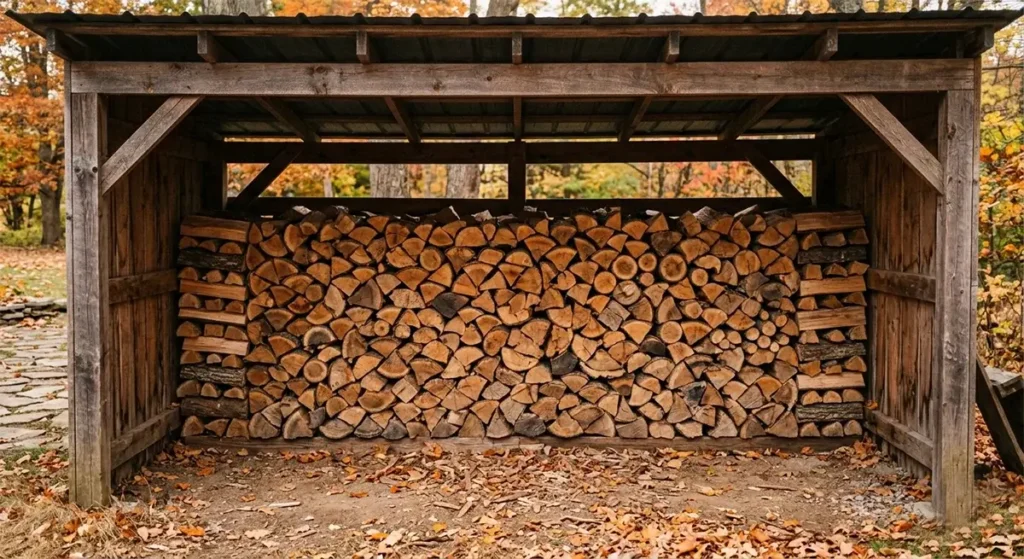
Split wood seasons dramatically faster than whole rounds because the exposed cross-grain surfaces allow moisture to evaporate. A round that might take 3 years to season will season in 9 to 12 months when split into 4 to 6-inch pieces. Stack split wood in single-layer rows off the ground — on pallets or dimensional lumber — with the split faces oriented to catch prevailing winds. Two-foot-wide rows allow air to circulate freely. Cover just the top of the stack with a tarp or metal panel to keep rain and snow off while maintaining airflow through the sides. Completely wrapping a woodpile in plastic traps moisture and encourages mold and rot. South-facing stacks with good wind exposure dry the fastest.
How Much Firewood Do You Need?
A cord of wood is a standardized unit: 4 feet wide x 4 feet high x 8 feet long = 128 cubic feet of stacked wood. The amount you need depends on your climate, home size, and stove efficiency. A well-insulated 1,500 square foot home in the mid-Atlantic states might burn 2 to 3 cords per winter. The same home in northern Minnesota might burn 5 to 6 cords. The U.S. Department of Energy’s Wood and Pellet Heating guide provides comprehensive information on choosing, installing, and operating wood heating systems efficiently and safely, including EPA-certified stove requirements that significantly improve combustion efficiency compared to older stoves.
Chimney Safety
The National Fire Protection Association recommends annual inspection and cleaning of all chimneys and flues by a CSIA-certified chimney sweep. Creosote — the tar-like byproduct of incomplete combustion — accumulates in the flue and is the primary cause of chimney fires. Burning only dry, seasoned hardwood is the best prevention. Burning hot, vigorous fires (not smoldering, low fires) also reduces creosote buildup significantly.
Building Your Woodshed
A dedicated woodshed is one of the most practical structures you can build on a homestead. A simple three-sided shed with a metal roof — open front facing south — keeps wood dry, organized, and ready to use. A woodshed sized for 4 to 5 cords of split wood requires approximately 10 x 20 feet of floor space at standard stack heights. Build it close enough to the house to make winter wood-hauling convenient (under 50 feet is ideal) but far enough away (at least 30 feet) to reduce pest and fire risk to the main structure.
Final Thoughts
A well-run firewood operation is one of the most satisfying and practical aspects of rural homestead life. The work is real, the results are immediate, and the independence from utility companies is tangible every time you feed a dry, properly seasoned piece of oak into your stove on a cold January morning. Start cutting and splitting this late winter for next winter. Stack it right, cover the top, and let time and wind do the rest. Your future self will thank you.

Leave a Reply