
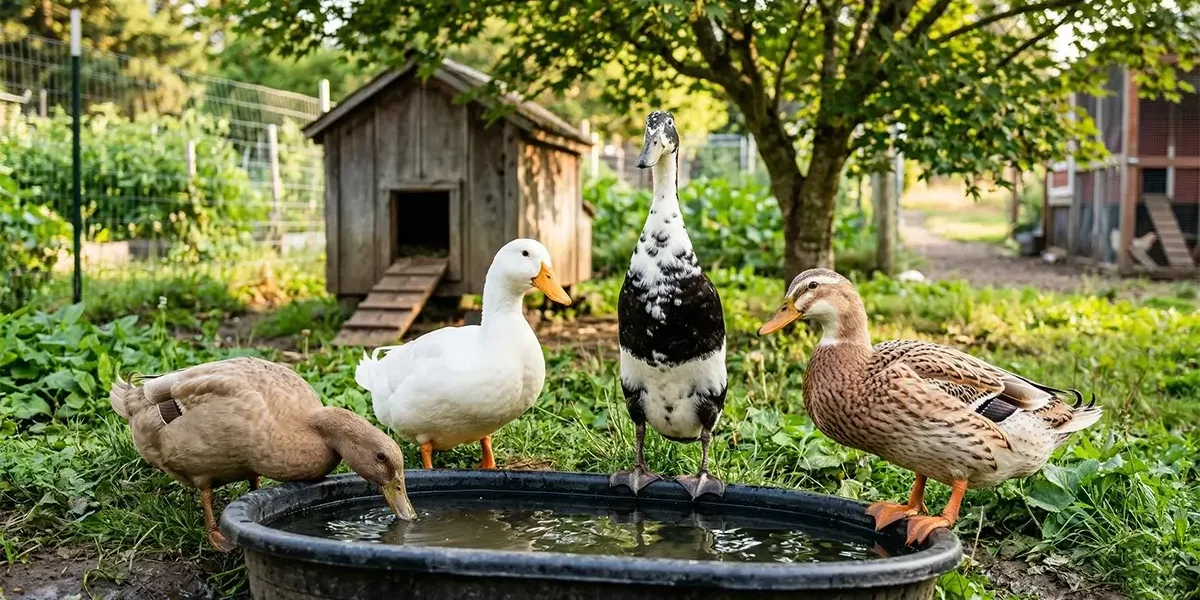
Ducks are one of the most underappreciated livestock additions a backyard homesteader can make. While chickens get most of the attention in the small-flock world, ducks offer a compelling set of advantages that make them an excellent choice — and in some respects a superior one — for the right homesteading situation. They are hardier in wet conditions, more resistant to common poultry diseases, extraordinarily productive egg layers in the best breeds, excellent for natural pest control in garden spaces, and frankly delightful to watch. This complete guide covers the best duck breeds for homesteaders, how they compare to chickens, and everything you need to successfully raise ducks for eggs and meat.
Ducks vs. Chickens: An Honest Comparison
Most people choose chickens by default because they are familiar. Before you commit, understand how ducks actually compare:
Where ducks win decisively: Disease resistance — ducks are significantly more resistant to Marek’s disease, Newcastle disease, and many common respiratory illnesses that regularly strike chicken flocks. Wet weather performance — ducks thrive in rain, mud, and cold wet conditions that stress and sicken chickens. Egg nutritional quality — duck eggs have larger yolks, higher fat and protein content, and more omega-3 fatty acids than chicken eggs. Pest control — ducks are exceptional slug, snail, and insect hunters in the garden. Cold weather hardiness — most duck breeds tolerate cold and wet winters far better than most chicken breeds.
Where chickens win: Space flexibility — chickens roost in trees and smaller coops; ducks need ground-level housing and ideally water access. Cleanliness — ducks are definitively messier with water and produce wet manure. Egg flavor and cooking — chicken eggs are preferred for baking by most cooks; duck eggs are richer and more strongly flavored. Roosting — ducks do not roost on bars; they need a dry, secure ground-level sleeping area. Feed efficiency — chickens typically convert feed to eggs more efficiently than ducks at equivalent production levels.
The Best Duck Breeds for Homesteaders
Khaki Campbell (Egg Production Champion)
If egg production is your primary goal, the Khaki Campbell is without competition the best dual-purpose homestead duck. Khaki Campbells were developed in England specifically for high egg production and routinely lay 280 to 340 large white eggs per year — a production rate that matches or exceeds the best laying chicken breeds. For comparison, a Buff Orpington chicken averages 200 to 280 eggs per year. Khaki Campbell eggs are large, rich, and excellent for both eating and baking. The ducks themselves are medium-sized (3.5 to 4.5 pounds), active foragers, highly disease-resistant, and maintain production year-round better than most chicken breeds. The downside: Khaki Campbells are not the friendliest or most handleable breed — they are nervous and flighty compared to larger, calmer breeds.
Indian Runner (Prolific Layer, Unique Appearance)
Indian Runners are the upright-standing, penguin-shaped ducks that have become increasingly popular with backyard flock keepers. They stand nearly vertical, run rather than waddle, and are outstanding egg producers at 250 to 300 large white or tinted eggs per year depending on the color variety. They are lightweight (3 to 5 pounds), fast-moving, excellent foragers, and exceptionally effective at slug and pest control in the garden. Their light body makes them a poor choice for meat production but outstanding for egg-only or garden pest control operations. Like Khaki Campbells, they are active and nervous rather than calm.
Pekin (Dual-Purpose Workhorse)
The white Pekin is the commercial standard for duck meat production in the United States and the breed most people picture when they think of a domestic duck. Pekins grow rapidly to 8 to 11 pounds at market weight, are excellent foragers, and are generally calm and easy to handle. Their egg production of 125 to 225 eggs per year is respectable though not in the Khaki Campbell class. Pekins are the most readily available breed across the country — available at most farm stores in spring — and are an excellent starting point for the homesteader who wants meat production with decent egg output.
Muscovy (Unique Breed, Outstanding Meat)
The Muscovy is technically not a duck in the taxonomic sense — it is a different species (Cairina moschata) that has been domesticated from South American wild ancestors. Muscovies are unique in several ways: they are the only domestic “duck” breed that regularly goes broody and raises their own young, eliminating the need for an incubator; they produce lean, red-fleshed meat that is compared to veal or lean beef rather than the fatty white meat of other duck breeds; the hens lay 60 to 120 eggs per year (far fewer than production breeds but concentrated in clutch-hatching cycles); and they are completely silent — Muscovy males make a hissing sound rather than the loud quack of other breeds. They are an outstanding homestead breed for those who want natural incubation and a self-sustaining flock.
Welsh Harlequin (Beautiful, Balanced Producer)
Developed in Wales from Khaki Campbell stock, the Welsh Harlequin combines beautiful feather patterning (similar to a mallard but lighter, with striking chestnut and cream patterns) with excellent production — 240 to 330 eggs per year — and a calmer, more handleable temperament than Khaki Campbells. They sex-link at hatch (males and females have different bill colors at hatching), simplifying flock sex identification. Welsh Harlequins are listed as threatened by the Livestock Conservancy and are an excellent choice for homesteaders interested in both productivity and breed conservation.
Rouen (Ornamental and Meat)
The Rouen is the large, heavy-bodied, magnificently colored breed that looks like an oversized wild Mallard. Rouens grow slowly to 8 to 12 pounds and are primarily raised for meat or as ornamental ducks. Egg production is modest at 35 to 125 eggs per year. Their quiet, calm temperament and striking appearance make them popular for farm ponds and mixed decorative-productive flocks, but they are not competitive with production breeds for either eggs or efficient meat conversion.
Housing Ducks: What They Actually Need
Duck housing is simpler in some ways and more demanding in others than chicken housing. Ducks do not need — and cannot use — roosting bars. They sleep on the ground, ideally on a dry layer of straw or wood shavings. A duck coop needs to be dry, draft-free, and completely predator-proof at ground level (including the floor — raccoons and mink will reach through wire mesh or dig under inadequately secured walls). Plan for 4 square feet per duck of interior sleeping space. Ventilation must be excellent — ducks breathe out more moisture than chickens and their manure is wet, creating significant humidity in a poorly ventilated space.
Ducks do not need a pond — a simple rubber livestock trough or a child’s hard plastic wading pool provides adequate water for bathing and preening. Change water at least every other day; ducks will render any standing water filthy within hours. Locate water away from the center of the duck run to reduce mud concentration around the coop entrance.
Feeding Ducks
Laying ducks require a feed with 16 to 18% protein and adequate niacin — this is a critical distinction from chicken feed. Ducks require significantly more niacin (Vitamin B3) than chickens for healthy bone and nerve development, especially during the growing phase. Commercial duck starter is formulated with adequate niacin, but if you feed chick starter to ducklings, supplement with brewer’s yeast at 1/4 cup per 5 pounds of feed. Adult laying ducks can be maintained on quality layer pellets (not crumbles — ducks struggle with small particles) supplemented with brewer’s yeast through the first 12 weeks of life.
According to the eXtension Poultry Nutrition resource, ducks in active lay should receive free-choice quality feed rather than restricted rations, as limited feed access during peak laying rapidly reduces egg production in high-performance breeds like Khaki Campbells and Indian Runners. Free-choice oyster shell for calcium supplementation applies equally to ducks as to chickens.
Duck Eggs: Flavor, Nutrition, and Uses
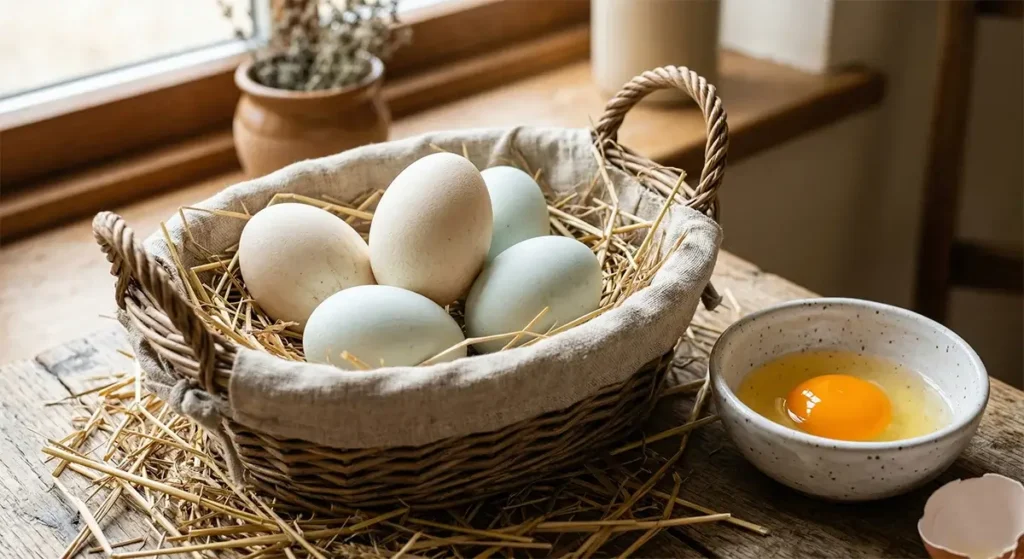
Duck eggs are larger than chicken eggs (an extra-large chicken egg weighs about 56 grams; a duck egg weighs 70 to 90 grams). The yolk is proportionally larger and higher in fat, giving baked goods made with duck eggs a noticeably richer texture and color. Professional bakers often prefer duck eggs for pastries, brioche, and custards for exactly this reason. The whites of duck eggs contain more protein than chicken egg whites, which some cooks find makes them cook slightly differently for omelets and scrambled eggs. The flavor is richer and fuller than a chicken egg but not “gamey” when the ducks are fed quality feed and have clean water access.
Duck eggs have a harder shell and thicker inner membrane than chicken eggs, giving them a longer refrigerator shelf life of up to 6 weeks versus 3 to 4 weeks for chicken eggs. They are fully interchangeable with chicken eggs in virtually all recipes on a one-for-one basis, substituting one duck egg for one chicken egg of equivalent size.
Protecting Your Ducks from Predators
Ducks face the same predator threats as chickens — raccoons, foxes, coyotes, mink, weasels, hawks, and owls — with one additional vulnerability: they cannot fly to escape ground predators and tend to freeze rather than flee effectively. Lock ducks in a secure coop every night without exception. During the day, a covered run with hardware cloth on all sides and overhead netting protects against aerial predators. Mink and weasels are a particular threat to duck operations near streams or ponds — they can enter through a half-inch gap and will kill an entire flock in one night. Inspect the coop regularly for any gaps at ground level.
Getting Started: Your First Duck Flock
For a beginner focused on egg production, start with four to six Khaki Campbell or Welsh Harlequin ducks. No drake (male) is necessary for egg production — hens lay unfertilized eggs as productively without a drake. Add one drake if you want to hatch your own replacements. Purchase sexed ducklings from a reputable hatchery to avoid the 50/50 sex ratio of straight-run batches. Ducklings require a brooder for the first 4 weeks, similar to chick brooders but with a critical difference — do not let ducklings have access to deep water until they are feathered out at 6 to 8 weeks. Young ducklings can drown in a few inches of water if they become chilled and cannot escape.
Final Thoughts
Ducks are not the right choice for every homestead — if you have limited space, need complete quiet, or cannot manage the water and mess that ducks inevitably create, chickens remain the more practical option. But for homesteaders with outdoor space, garden pest problems, or a preference for extraordinarily rich eggs, a small flock of Khaki Campbells or Welsh Harlequins is one of the most rewarding livestock investments you can make. They are hardy, productive, relatively disease-resistant, and genuinely entertaining to keep.

Leave a Reply