
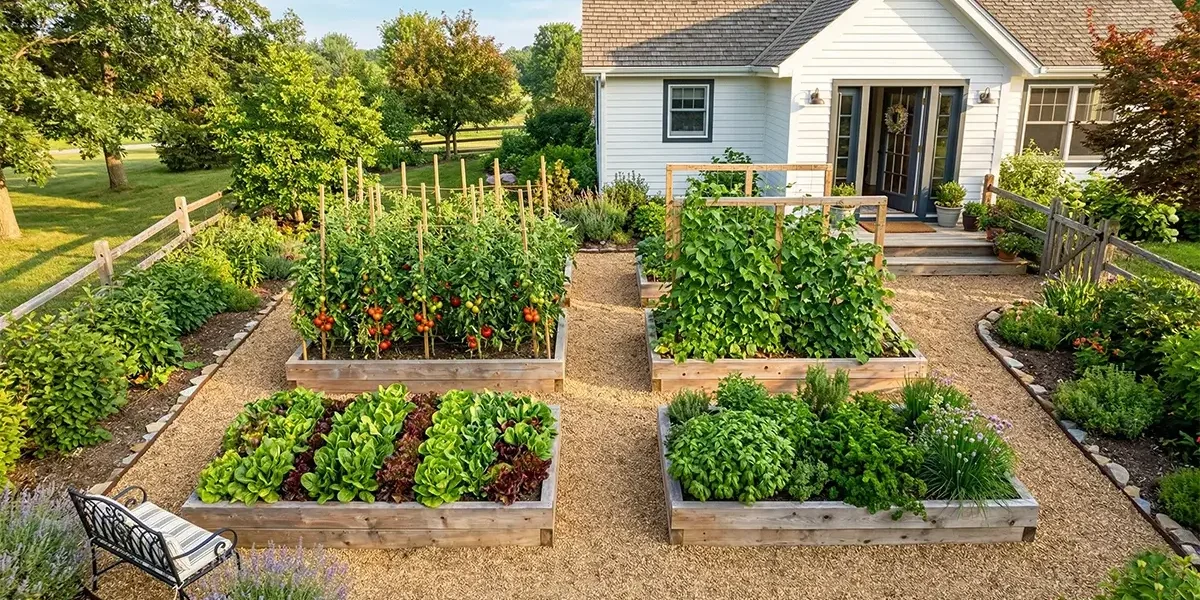
A kitchen garden — a productive, well-organized plot close to your home dedicated primarily to the vegetables, herbs, and salad greens you use most — is the single most rewarding gardening project most homesteaders ever undertake. Unlike a sprawling field garden planned for maximum yield, a kitchen garden is planned for maximum utility: the freshest possible ingredients available steps from your back door, harvested minutes before they reach the table. This guide covers how to plan, build, plant, and maintain a productive kitchen garden from scratch, whether you are starting with a blank backyard or converting an existing garden into a more functional layout.
What Is a Kitchen Garden and Why Is It Different?
The term “kitchen garden” (or in French, potager) refers specifically to a garden planned around the needs of the kitchen — what your household actually cooks and eats — rather than what is easiest to grow or most abundant. A kitchen garden is typically located close to the house for daily access, maintained intensively in a relatively small area, and planted in a rotation that ensures continuous harvests of the highest-priority crops throughout the growing season. It is distinct from a market garden (planned for commercial sale), a victory garden (planned for maximum caloric production), or a cutting garden (planned for flowers). The kitchen garden is planned for the table.
The ideal kitchen garden size for a family of four who cooks from scratch regularly is approximately 200 to 400 square feet of intensive growing space. This is small enough to maintain thoroughly without overwhelming, yet large enough to provide the majority of daily vegetable and herb needs through the growing season when managed intensively. Many families find that a 400 square foot kitchen garden meaningfully reduces their grocery bill while providing dramatically fresher produce than any store can supply.
Choosing the Right Location
Before you plan a single square inch of garden beds, you must site your kitchen garden correctly. The three non-negotiable siting requirements are sunlight, drainage, and proximity.
Sunlight: A minimum of 6 hours of direct sunlight per day is required for fruiting vegetables — tomatoes, peppers, cucumbers, beans, and squash. Salad greens and herbs tolerate 4 to 5 hours of sun but produce more abundantly in full sun. Walk your intended site at 10am, 1pm, and 4pm on a clear day and observe actual sunlight — not what you estimate based on compass direction. Shade from structures or mature trees changes significantly with season and time of day.
Drainage: Kitchen gardens require well-drained soil that does not hold standing water after rain. Waterlogged beds rot seeds, drown roots, and create the anaerobic soil conditions that favor fungal disease. If your site holds water for more than 30 minutes after a rain, build raised beds elevated 8 to 12 inches above grade.
Proximity: Locate your kitchen garden as close to the kitchen door as your site allows. Research consistently shows that gardens farther than 50 steps from the kitchen are visited less frequently, harvested less often, and maintained less consistently than gardens immediately adjacent to the house. Accessibility drives maintenance — make it easy.
Designing the Layout
The most functional kitchen garden layouts use permanent raised beds with defined pathways. Permanent beds eliminate the compaction that damages soil structure in traditionally tilled gardens, allow soil biology to develop undisturbed, and can be maintained standing upright without stepping into the growing area. Standard raised bed dimensions: 4 feet wide maximum (allowing comfortable reach to the bed center from either side) and any practical length from 4 to 12 feet. Pathways should be minimum 18 inches wide — 24 inches is more comfortable for kneeling, using a wheelbarrow, and working with tools.
A functional layout for a 400 square foot kitchen garden might include: four 4×8-foot beds (128 square feet of growing space) arranged in two parallel rows of two with 2-foot paths between them, a central 3-foot main path, a perimeter path of 18 inches, and a small dedicated herb bed nearest the kitchen door. This arrangement provides about 128 square feet of actual growing space — enough for a productive intensive garden — in a total footprint of approximately 20×20 feet.
Building Raised Beds on a Budget
Raised beds can be built from many materials at a wide range of costs. The most common options:
Untreated cedar or redwood (premium, longest-lasting): Naturally rot-resistant, lasts 10 to 15 years in direct soil contact. 2×8 or 2×10 boards for sides, screwed at corners. A 4×8 cedar bed costs $40 to $80 in materials.
Galvanized steel corrugated panels (modern, very durable): The increasingly popular choice for visually clean, very long-lasting beds. Galvanized steel does not leach chemicals, lasts 20 to 30 years, and is available in landscape-focused kits from $80 to $200 for a standard 4×8 bed. The metal walls warm quickly in spring and extend the growing season.
Landscape timbers or railroad ties (caution): Old railroad ties may be treated with creosote, a known carcinogen — avoid for vegetable gardens. Untreated landscape timbers in 6×6 size work but rot within 5 to 7 years. If using landscape timbers, look for heat-treated (HT) rather than chemically treated lumber.
No-cost option — in-ground beds with edged borders: If your native soil drains well and is reasonably good quality, simple in-ground growing beds defined with a string line and a flat-nosed spade require zero material cost. This is how millions of successful kitchen gardens have been grown throughout history.
Building the Perfect Kitchen Garden Soil Mix
The soil in a raised bed kitchen garden is entirely within your control — unlike native soil, you build it from scratch and improve it with every season. A classic productive raised bed mix is the “Mel’s Mix” formula developed by Mel Bartholomew for the Square Foot Gardening method: 1/3 coarse vermiculite (for drainage and aeration), 1/3 peat moss or coco coir (for moisture retention and organic structure), and 1/3 blended compost (preferably from multiple sources for diversity of nutrients and biology). For a standard 4x8x12-inch deep bed, you need approximately 32 cubic feet (slightly over 1 cubic yard) of soil mix.
This mix is lightweight, drains excellently, resists compaction, and starts productive immediately. It is more expensive than filling with garden soil — expect to spend $100 to $150 per 4×8 bed in mix ingredients — but the superior performance dramatically justifies the investment in a kitchen garden context. According to research from the Utah State University Extension, raised beds with optimized growing media consistently produce 2 to 3 times the yield of equivalent in-ground beds in heavy clay or poor-quality native soils.
What to Grow in Your Kitchen Garden
The right answer is deeply personal — plant what your household actually eats. Before you plan a single bed, write down every vegetable and herb your family uses in a typical week, ranked by frequency of use. Those top-ranked items are your priority crops. Common kitchen garden priorities include:
Daily-use herbs (plant closest to kitchen door): Basil, flat-leaf parsley, chives, thyme, oregano, rosemary, and mint (keep mint in a container — it spreads aggressively). One plant of each herb is typically adequate for a family of four.
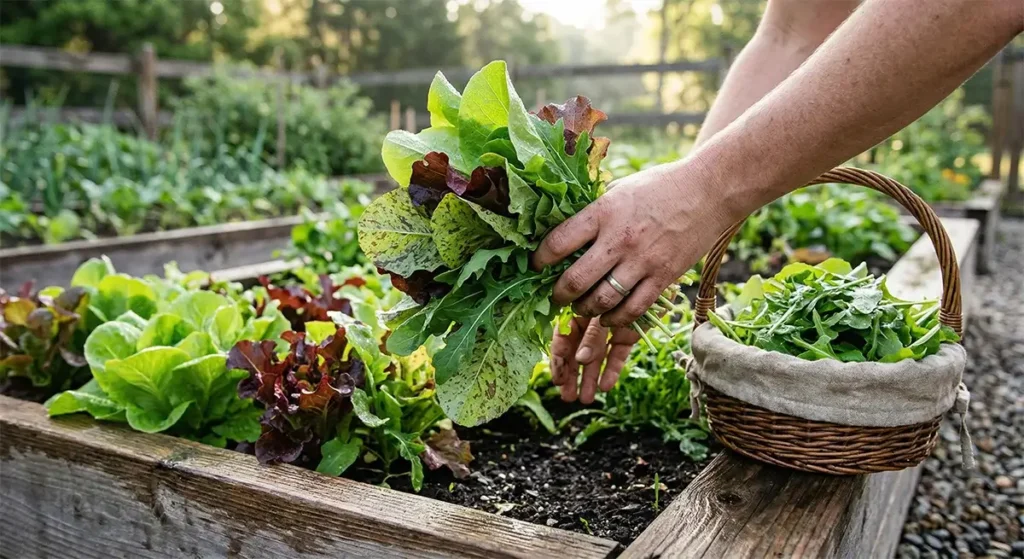
Salad crops (succession plant every 2-3 weeks for continuous supply): Mixed lettuce, arugula, spinach, and radishes. These are the fastest-return crops in the kitchen garden — some lettuce varieties are ready to cut within 30 days of transplanting.
High-value summer crops: Cherry tomatoes (one or two well-chosen varieties produce continuously from July through frost), cucumbers (two plants are usually plenty), and peppers (both sweet and hot).
Practical bulk crops: Green beans, zucchini (one plant is usually enough — one of the most productive vegetables per square foot), and Swiss chard or kale for fall and winter harvests that extend the kitchen garden season.
Succession Planting: The Secret to Continuous Harvest
The single most effective technique for maximizing kitchen garden productivity is succession planting — making small, staggered plantings every 2 to 3 weeks rather than planting everything at once. A single large planting of lettuce produces a short window of abundant harvest followed by nothing. Six small plantings spaced 2 weeks apart produces a continuous, manageable harvest across 12 weeks. Apply succession planting to: lettuce and salad greens, radishes, green beans, beets, cilantro, dill, and spinach.
Watering Your Kitchen Garden
Raised bed kitchen gardens dry out faster than in-ground gardens because the elevated, well-drained soil has less thermal mass and more exposed surface area. During summer heat, daily or every-other-day watering is typically necessary. Drip irrigation on a simple timer is the most efficient solution — it delivers water at root level, keeps foliage dry (reducing foliar disease), and can run in the morning while you are sleeping. A basic drip system for four 4×8 beds with a timer runs $50 to $120 in materials and eliminates most hand-watering labor.
Extending Your Kitchen Garden Season
A kitchen garden equipped for season extension delivers fresh produce for 10 to 12 months per year in most American climates. Key season extension tools: a cold frame (a simple bottomless box with an old window for a lid) extends spring planting by 4 to 6 weeks and fall harvesting by 4 to 6 weeks with zero heating cost. A low tunnel of row cover fabric (Agribon AG-19 or similar) provides 2 to 4°F of frost protection with minimal cost. For winter salad production in Zones 6 and warmer, an unheated hoop house or high tunnel can maintain productive salad greens all winter with no supplemental heat.
Final Thoughts
A well-planned kitchen garden delivers more tangible, daily value than almost any other homestead project. The connection between your garden and your table shortens to almost nothing — you walk out the door, harvest what you need, and cook with it within minutes. Start smaller than you think you need, build soil deliberately, plant what your kitchen actually uses, and practice succession planting from your first season. The kitchen garden pays off in fresh food, saved money, and daily satisfaction every single growing season.

Leave a Reply