
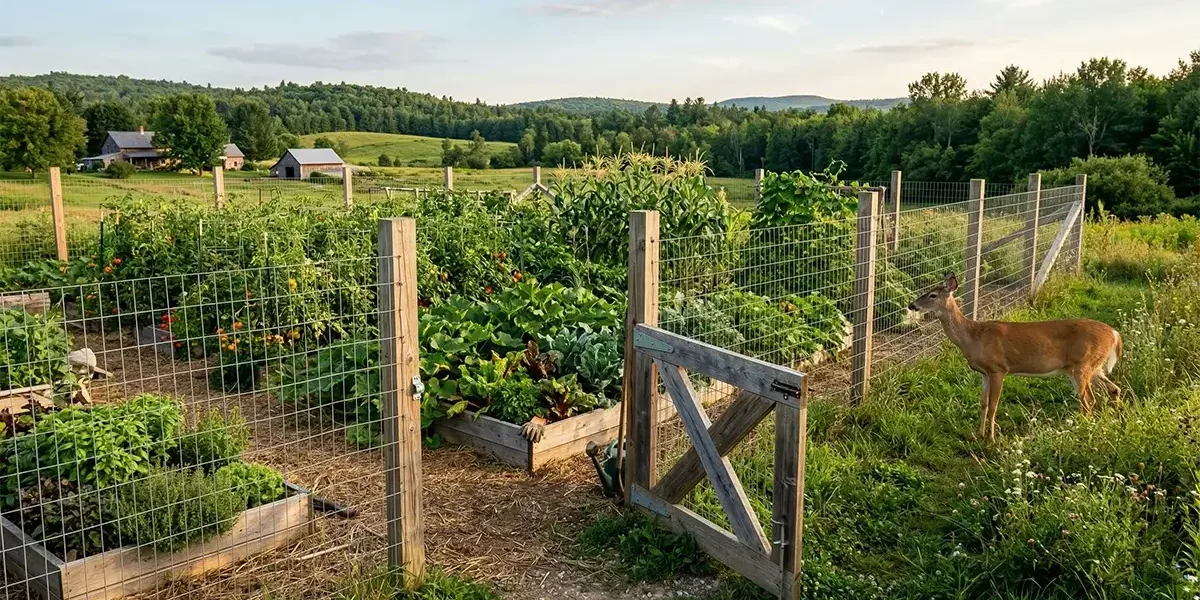
Every serious homestead vegetable garden needs good fencing. Whether you are protecting raised beds from rabbits, keeping deer out of a quarter-acre kitchen garden, or building livestock-proof perimeter fencing around a full market garden, the right fence installed correctly is the difference between a productive harvest and a frustrating season of replanting what the wildlife ate. This guide covers the most practical fencing options for homestead gardens of all sizes — from simple rabbit-proof wire around raised beds to deer-exclusion systems that reliably protect large garden spaces.
Why Most Garden Fencing Fails
Before choosing a fencing system, it helps to understand why the most common garden fences fail. Chicken wire is the most widely sold “garden fence” at every hardware store in America — and it is inadequate for most situations. Standard chicken wire has openings large enough for rabbits to squeeze through, is too lightweight to resist persistent deer pressure, bends easily at ground level allowing small rodents to push under, and rusts and deteriorates within 3 to 5 years in most climates. It works marginally for keeping chickens in an enclosed run but is not a reliable garden perimeter fence against rabbits, groundhogs, or deer. Understanding the specific pest you are excluding determines your fencing system.
Know Your Pest Before You Fence
The most common garden pests that require fencing, and what each one demands:
Rabbits squeeze through 2-inch openings, burrow under fences, and rarely jump over barriers higher than 2 feet. Effective rabbit exclusion requires wire with openings no larger than 1 inch, buried 6 to 12 inches below grade, and at least 2 to 3 feet above grade. Rabbits are the most common garden pest in suburban and rural areas across the United States.
Groundhogs (woodchucks) are powerful burrowers that can undermine almost any fence without a buried apron. They also climb fences up to 4 feet tall if motivated by the garden inside. An electric wire offset 4 to 5 inches outside the fence at 4 to 5 inches above ground level is the most reliable groundhog deterrent.
Deer jump extremely well — a motivated deer can clear a 6-foot fence. Effective deer exclusion requires 7 to 8 feet of height or a double-fence system that exploits deer’s reluctance to jump into a narrow, confined space. Deer are the most damaging garden pest for rural homesteads across the eastern United States.
Chickens and ducks (your own livestock) need standard poultry fencing around garden areas when free-ranging near vegetable beds. Chickens can fly over 4-foot fences; clip one wing to limit flight height or use covered runs.
The Best Fencing Options for Homestead Gardens
Option 1: Hardware Cloth — The Premium Rabbit and Small Pest Fence
Hardware cloth (welded wire mesh with 1/2-inch or 1/4-inch openings) is the gold standard for excluding rabbits, mice, voles, and small animals from raised beds and enclosed garden spaces. Available in 2-foot, 3-foot, and 4-foot heights, 19-gauge or 23-gauge wire. The 1/2-inch opening size excludes rabbits and most rodents; the 1/4-inch opening size excludes even mice and voles, important for protecting root vegetables and bulbs.
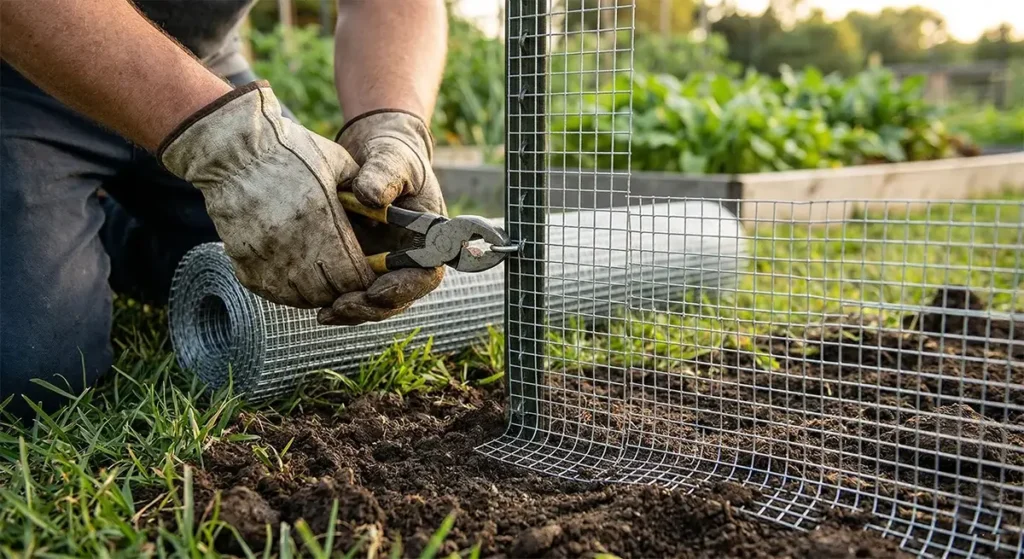
Installation: Drive 36-inch T-posts or wooden stakes every 6 to 8 feet. Attach hardware cloth with zip ties, hog rings, or fence staples. Bend the bottom 6 inches of wire outward at a 90-degree angle before burying — this creates an underground “L” that prevents burrowing animals from digging at the base of the fence. Backfill the buried apron with soil. Add a gate using a simple wooden frame wrapped in hardware cloth and hung with standard gate hinges. Cost: $0.80 to $1.50 per linear foot for 2-foot hardware cloth, plus posts.
Option 2: Welded Wire Field Fence — The Workhouse Garden Perimeter
For large garden enclosures of 1,000 square feet or more where hardware cloth would be prohibitively expensive, welded wire field fence in 2×4-inch openings offers a practical compromise. It excludes deer (at 6-foot height), keeps chickens out (at 4-foot height with clipped wings), and blocks most medium to large animals. Its limitation is that 2×4-inch openings allow rabbits to pass — address this by adding a 24-inch skirt of chicken wire or hardware cloth at the base, buried 6 inches below grade. Field fence is significantly less expensive than hardware cloth — approximately $0.30 to $0.60 per linear foot for 4-foot field fence, installed.
Option 3: Electric Fencing — The Most Cost-Effective Deer Solution
For deer exclusion over large garden areas, a properly designed electric fence system is the most cost-effective option by a significant margin. A 5-strand high-tensile electric fence at 7 feet tall costs a fraction of a 7-foot woven wire or welded wire fence. The key design principle for deer: deer jump height is determined more by their willingness to attempt the jump than their physical capability. A double-fence system — two parallel electric fences 3 to 4 feet apart at 4 to 5 feet height — exploits deer’s reluctance to jump into a narrow space from which they cannot clearly see an exit. This “psychological fence” consistently excludes deer at a much lower height (and cost) than a single tall barrier.
A basic Zareba or Fi-Shock energizer suitable for a 1-acre garden perimeter costs $60 to $150. Ground rods, posts, wire, and insulators for a perimeter of 400 linear feet add approximately $150 to $250. Total electric fence system for 400 feet of deer perimeter: $210 to $400, compared to $800 to $1,600 for a 7-foot woven wire perimeter at the same size.
Option 4: Deer Netting — Simple, Inexpensive, Effective
Polypropylene deer netting (commonly called “deer fence” or “critter fence”) sold in 7-foot and 8-foot heights is a genuinely effective deer exclusion solution for gardens where appearance matters and deer pressure is not extreme. It is nearly invisible from more than 20 feet away, installs in hours, costs $0.10 to $0.25 per square foot for the netting, and lasts 10 to 15 years if not subjected to heavy snow loading or frequent deer contact. It does require posts every 10 to 15 feet (rebar, T-posts, or wooden stakes) and tensioning to prevent sagging.
Netting limitation: it is not rodent-proof, not groundhog-proof, and tears if deer push hard against it or run through it. It works best where deer approach cautiously rather than under pressure from predators or crowding.
Building a Complete Homestead Garden Fence: Step by Step
For a large kitchen or market garden requiring protection from multiple pests, a combination fence is the most thorough solution. Here is a practical build sequence for a combined rabbit-and-deer exclusion fence around a 50×80-foot garden (260 linear feet of perimeter):
Materials: Twenty-six 8-foot T-posts (10-foot spacing); 260 feet of 4-foot 2×4-inch welded wire field fence; 260 feet of 24-inch hardware cloth for the rabbit skirt; staples and zip ties; a gate kit or materials to build a 4-foot gate; a post driver; fence pliers; wire cutters.
Step 1: Mark the perimeter with stakes and string line. Mark gate location.
Step 2: Drive T-posts to 18-inch depth (leaving approximately 6.5 feet of post above grade) at 10-foot intervals around the perimeter. Drive corner posts and gate posts deeper — 24 inches — for additional stability.
Step 3: Unroll field fence and attach to posts starting at one corner, using fence staples or zip ties at top, middle, and bottom of each post. Keep fence pulled taut between posts using a fence stretcher or come-along.
Step 4: Attach 24-inch hardware cloth along the base of the field fence, overlapping by 2 inches. Bend the bottom 6 inches outward and bury 6 inches below grade.
Step 5: Build or install the gate. A wooden gate frame of 1×4 cedar or 2×2 construction lumber covered in hardware cloth, hung with two 3-inch hinges on a securely set wooden gate post, is effective and inexpensive.
The Penn State Extension guide on protecting gardens from deer provides research-backed comparisons of deer exclusion methods including cost-effectiveness data, plant repellent efficacy, and regional deer behavior patterns that affect which fencing approach works best in different parts of the country.
Maintaining Your Garden Fence
A garden fence that is not maintained deteriorates faster than most homesteaders expect. Walk the entire perimeter monthly during the growing season. Check for posts leaning from frost heave or wind; tighten loose wire; repair any gaps at ground level immediately — once a rabbit discovers an entry point, it will use it repeatedly. Clear vegetation from the base of the fence line twice per season — tall grass growing against wire holds moisture and accelerates rust. For electric fences, check energizer voltage with a fence tester monthly and after significant storms that might have shorted the fence with fallen vegetation.
Row Covers as a Low-Tech Alternative
For small garden areas or individual beds, floating row cover fabric (Agribon AG-19 or Reemay) supported on wire hoops provides both pest exclusion and frost protection in one inexpensive solution. Row cover fabric with 1 to 2 ounces per square yard weight allows light, air, and rain to pass through while physically excluding most insects, birds, and small mammals. It is the most economical solution for protecting vulnerable transplants and seedlings from pest pressure during the first critical weeks after planting.
Final Thoughts
Garden fencing is an investment that pays for itself in the first season it prevents a crop loss. A deer visit on a June night can destroy an entire season’s worth of tomatoes, peppers, and beans that represent dozens of hours of labor. Build once, build correctly, and the fence protects your garden for a decade or more. Assess your specific pest pressure, choose the appropriate fencing system for your target pests and budget, install it properly with a buried apron, and your investment will pay for itself many times over.



Leave a Reply