
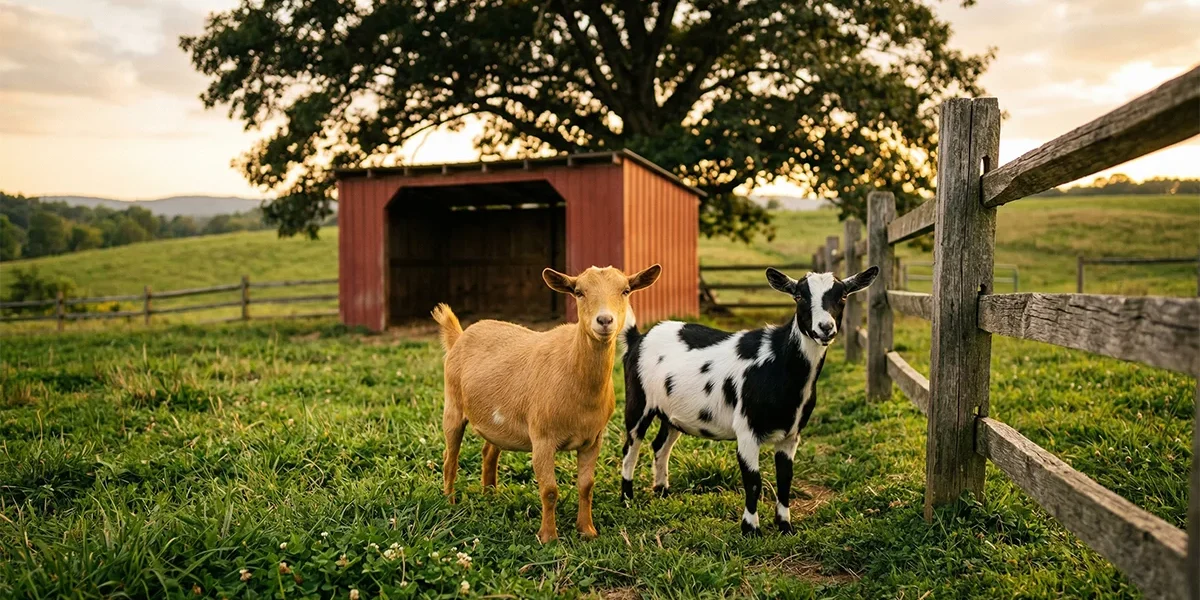
Dairy goats are one of the most practical and rewarding livestock additions a small homestead can make. A single productive doe can supply a family with fresh milk, cheese, yogurt, butter, and soap-making ingredients from as little as one-tenth of an acre. They are browsers, not just grazers, which means they thrive on brushy land that cattle and sheep cannot use productively. This comprehensive guide covers everything you need to know to raise goats on a small homestead — from breed selection and housing to feeding, breeding, milking, and health management.
Why Goats Are Perfect for the Small Homestead
Goats occupy a unique and valuable niche in small-scale homesteading because of their efficiency, versatility, and relatively low barrier to entry. Compared to a dairy cow — which requires significant acreage, expensive feed, and specialized equipment — a dairy goat fits comfortably into a modest homestead operation. Two Nigerian Dwarf does can provide a family of four with one to two quarts of rich, high-butterfat milk per day combined, eating a fraction of what a cow consumes.
Beyond dairy production, goats serve as effective brush and weed control, clearing invasive species and overgrown areas that would otherwise require a tractor or hours of manual labor. Their manure is a valuable, relatively dry fertilizer that can be added directly to compost or applied to garden beds with minimal odor. Meat breeds and crossbreds also provide lean, flavorful protein, and smaller breeds can be raised in spaces that would be impractical for larger livestock.
Choosing the Right Breed for Your Goals
Goat breeds divide broadly into three categories: dairy breeds (selected for high milk volume and quality), meat breeds (selected for rapid weight gain and body conformation), and dual-purpose breeds that balance both. Your goals determine your breed selection.
Top Dairy Breeds for Homesteaders
Nigerian Dwarf: The most popular homestead dairy breed for small properties. Nigerian Dwarfs are compact — standing 17 to 21 inches at the shoulder — but produce milk with 6 to 10% butterfat, the highest of any dairy breed. One well-managed doe produces half a gallon to one gallon per day at peak lactation. Their small size means lower feed costs, easier handling, and minimal fencing demands. They are also friendly, personable, and excellent for families with children.
Nubian: A large, long-eared breed known for rich, sweet-tasting milk with 4 to 5% butterfat — higher than most large breeds. Nubians are vocal (their bleating carries farther than most breeds) and affectionate. Production averages 1 to 2 gallons per day at peak. They are heat-tolerant and popular across the American South and Southwest.
LaMancha: Distinguished by extremely short or absent external ear pinnae, LaManchas are quiet, calm, and highly productive — 1.5 to 2 gallons per day with 3.5 to 4% butterfat. Their calm temperament makes them the easiest large breed to manage for beginners.
Alpine: Hardy, adaptable, and one of the highest-producing dairy breeds — up to 2 gallons per day at peak. Alpines are assertive and independent, making them better suited for experienced goat keepers. They thrive in cold climates and are excellent foragers.
Top Meat Breeds
Boer: The standard commercial meat goat breed worldwide. Boers grow rapidly to 150 to 300 pounds and have exceptional feed conversion. Purebred Boer does are sometimes poor milkers, making them less practical for dual-purpose homestead use without a dairy cross.
Kiko: Developed in New Zealand for parasite resistance and low-input management. Kikos thrive on browse and minimal supplemental feed, making them an excellent choice for homesteaders who want meat production with minimal inputs.
Housing Requirements for Goats
Goats require dry, draft-free shelter that protects them from rain and cold. They do not tolerate wet conditions well — wet hooves lead to foot rot, and wet coats in cold weather can cause hypothermia in kids. The basic shelter requirements are straightforward:
Plan for 15 to 20 square feet of dry indoor space per adult goat. A three-sided loafing shed facing south or east works well in most American climates. Full four-sided barns with ventilation are necessary in regions with severe winters. Avoid dirt floors if possible — concrete with rubber mats or packed gravel with deep bedding drains better and is easier to manage. Use straw or wood shavings for bedding, replacing or adding fresh material at least weekly.
Goats are escape artists. This is not an exaggeration — it is the defining characteristic of the species from a management standpoint. Fencing for goats must be tight, smooth, and tall. The most effective options are welded wire field fence (minimum 4 feet tall, preferably 5 feet) with an electric offset wire at nose height and at the top, or well-tensioned high-tensile electric fence with at least 5 electrified strands. T-post spacing should be no more than 8 feet for field fence with goats. A single strand of hot wire at the bottom inside the fence prevents goats from pushing under. Inspect all fence lines monthly and repair gaps immediately — a goat that learns it can escape will teach every other goat in your herd.
Feeding Goats on a Small Homestead
Goats are ruminants and, contrary to popular belief, they are selective browsers rather than indiscriminate eaters. They prefer browse — leaves, shrubs, tree bark, and woody stems — over grass pasture. A proper goat diet consists of roughage (hay or pasture) as the foundation, supplemented by concentrate (grain) for production animals and free-choice loose minerals.
Hay
Good quality grass hay — timothy, orchard grass, coastal Bermuda — or mixed grass-legume hay forms the base of the non-pasture diet. An adult goat eats approximately 2 to 4 pounds of hay per day. Alfalfa hay is an excellent choice for lactating does due to its high calcium and protein content but should be fed in moderation to dry does and bucks to prevent urinary calculi. Always provide free-choice hay — goats that run out of roughage will overeat grain, leading to bloat and digestive upset.
Grain and Concentrates
Lactating does in production need 1 to 2 pounds of a 16% protein grain ration per day depending on milk production level — more milk means more grain. Dry does, bucks, and wethers generally do not need supplemental grain beyond good-quality hay and pasture. Overfeeding grain to non-lactating animals causes obesity and reproductive problems.
Minerals
Free-choice loose goat mineral is essential and non-negotiable. Goats have specific mineral requirements that differ from cattle and sheep — do not substitute cattle mineral or sheep mineral, as sheep mineral lacks the copper that goats need in meaningful quantities. In selenium-deficient regions (most of the eastern United States), a selenium-vitamin E supplement is also important. Your local cooperative extension office and the Merck Veterinary Manual’s goat nutrition guidelines provide detailed regional guidance on mineral supplementation strategies.
Breeding and Kidding
Goats are seasonally polyestrous — most breeds cycle and breed in fall as day length shortens, kidding in late winter or early spring after a 150-day gestation. Nigerian Dwarfs are an exception, cycling year-round and allowing flexible breeding schedules. Does should not be bred before 7 to 8 months of age and at least 60% of their expected mature body weight. Breeding underweight does leads to difficult deliveries and poor kid survival rates.
Does typically kid 148 to 152 days after breeding. Most goats kid easily without assistance, but first-fresheners (does kidding for the first time) and large litters (triplets and quads are common in dairy breeds) may need help. Have a kidding kit ready: iodine for navels, clean towels, a heat lamp, colostrum supplement in case the doe’s colostrum supply is inadequate, and your veterinarian’s phone number. Kids must receive colostrum within the first two hours of birth — this is critical for immune system development and cannot be replaced by regular milk or formula.
Milking Your Does
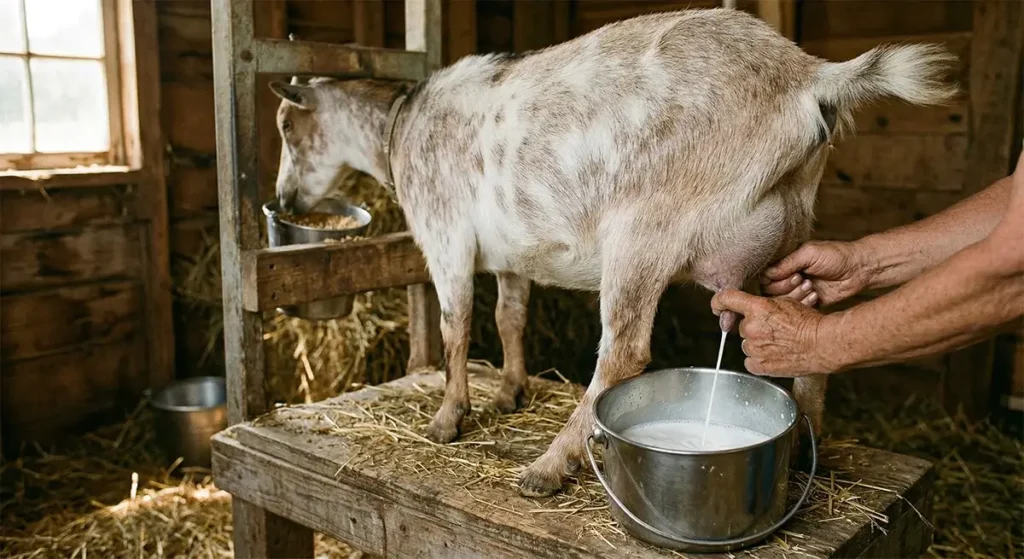
Does must be milked consistently — once or twice daily — every day throughout their lactation period, which typically lasts 10 months in dairy breeds. Irregular milking signals the doe’s body to reduce production and can lead to mastitis. A simple, clean milking routine consists of wiping the udder with a warm damp cloth, discarding the first few streams from each teat (which flush any bacteria in the teat canal), milking completely until the udder is soft and empty, and applying a post-milking teat dip to prevent infection.
Fresh goat milk that is properly chilled immediately after milking has a clean, sweet flavor completely unlike the strong “goaty” flavor many people associate with commercial goat milk. That off-flavor develops when milk is not chilled quickly, is handled near a buck, or comes from a doe with undetected mastitis. Invest in a stainless steel milk pail, a stainless filter, and glass storage jars. Chill milk to below 40°F within 30 minutes of milking for the best flavor and longest shelf life.
Common Health Issues in Homestead Goats
Goats are generally hardy animals but are susceptible to several health conditions that every homesteader should know:
Internal parasites (Barber pole worm — Haemonchus contortus): The number one killer of goats in the eastern United States. Unlike most livestock parasites, Haemonchus is a blood-sucking worm that can cause severe anemia and death rapidly, especially in young animals and during warm, wet seasons. Use the FAMACHA system — checking the color of the goat’s inner eyelid mucous membrane — to identify anemic animals that need deworming rather than deworming the entire herd on a schedule. Rotational grazing and keeping browse available reduces exposure. Develop a deworming strategy with your veterinarian.
Urinary calculi (UC): A blockage of mineral deposits in the urethra, almost exclusively affecting wethers and bucks. Prevent by feeding adequate roughage (hay), maintaining proper calcium-to-phosphorus ratios, ensuring constant access to fresh water, and adding ammonium chloride to the ration of high-risk animals. UC is a veterinary emergency.
Enterotoxemia (overeating disease): Caused by Clostridium perfringens bacteria that proliferate when animals suddenly eat large amounts of grain. Prevent with annual CDT vaccination (Clostridium C and D plus tetanus) and by never making sudden changes to grain rations.
Mastitis: Inflammation of the udder caused by bacterial infection. Monitor milk daily for clumps, discoloration, or reduced production from one half of the udder. California Mastitis Test strips provide a simple on-farm screening tool. Prompt treatment with appropriate antibiotics prescribed by your veterinarian is essential.
Getting Started: Minimum Requirements for Two Dairy Does
To start a basic two-doe dairy operation on a small homestead you need: a three-sided shed with 40 square feet of dry floor space; a minimum half-acre of well-fenced browse or pasture; a simple milking stand (a raised platform with a stanchion head-catch, easy to build for under $50 in materials); basic milking equipment (stainless pail, filter, jars); a loose mineral feeder; and access to quality hay year-round. Budget $300 to $800 for does depending on breed, registration status, and milk production records. Total first-year startup cost for a two-doe operation typically runs $1,500 to $3,000 including fencing, shelter improvements, and equipment.
Final Thoughts
Dairy goats reward the homesteader who pays attention to their specific needs — good fencing, consistent milking, proper mineral nutrition, and proactive parasite management. When those needs are met, a small goat herd returns a remarkable amount of food, fertility, and satisfaction from a very modest piece of land. Start with two does of a breed that matches your climate, property size, and goals. Learn the rhythms of their cycle through a full year. Then expand when you are ready.

Leave a Reply